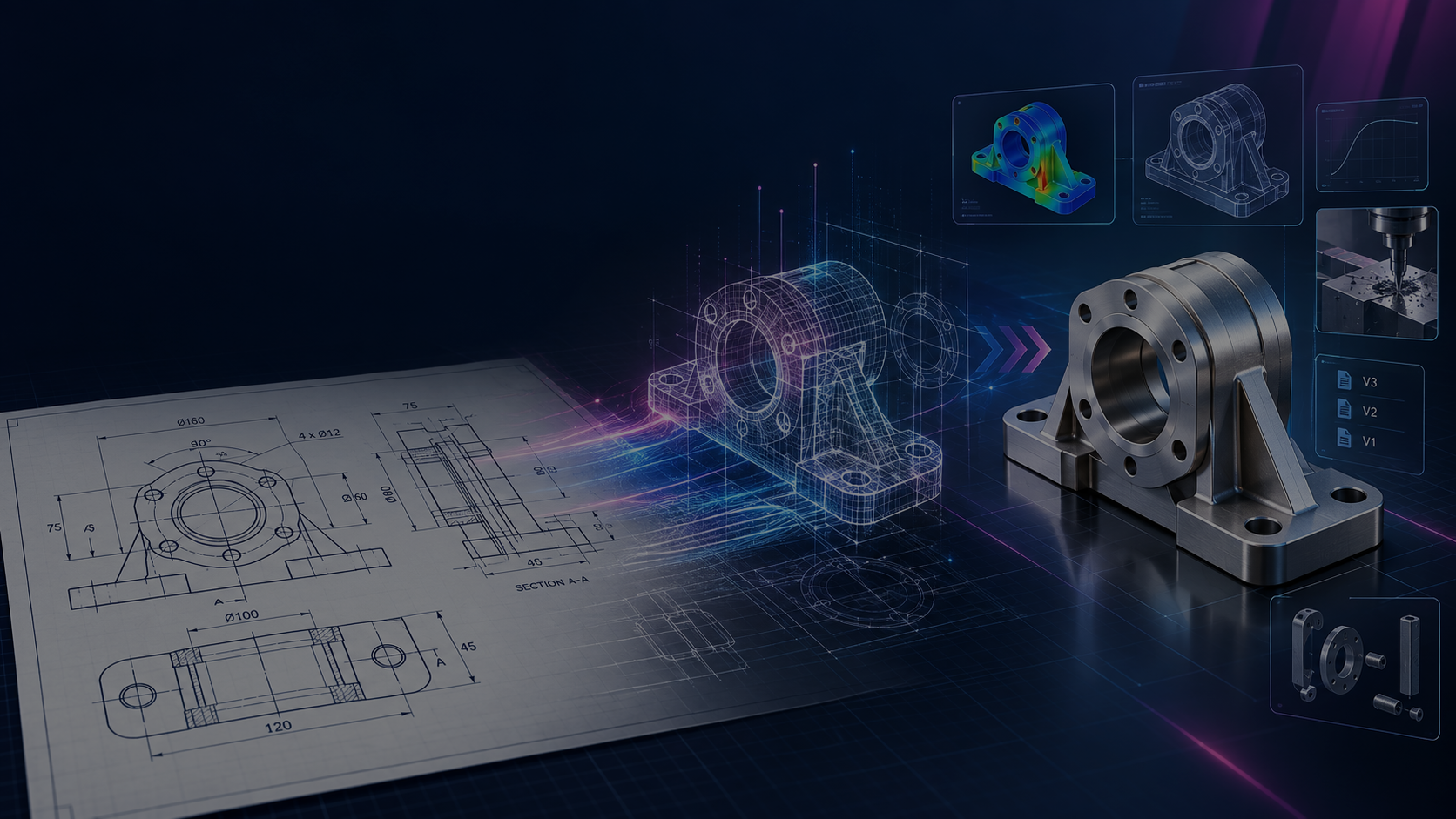
Every manufactured product begins as an idea, an insight about a problem, a conceptual sketch, or a performance requirement. But between that initial concept and the moment a finished part is held in hand, there is a complex, technical translation process that determines whether the idea survives contact with reality. That translation process is product design and development drafting.
In mechanical engineering, drafting is not a clerical function. It is the discipline that ensures production releases build upon more than just the creative and functional intent; it converts these elements into precise, unambiguous language that manufacturing systems, fabricators, and quality inspectors can act upon. Without it, the distance between a designer's vision and a manufacturer's output remains a source of continuous error, rework, and commercial loss.
The Gap Between Concept and Production
The concept-to-production gap is one of the most persistent challenges in mechanical product development. It is not primarily a gap in technical knowledge; most engineering teams understand their product well. It is a gap in documentation precision: the difference between knowing what a part should do and communicating that knowledge in a form that leaves no room for interpretation.
A product designer working in CAD knows exactly how every feature functions and how every tolerance was derived. A fabricator in a different facility, working from exported drawings, has only the documentation. If that documentation is ambiguous, incomplete, or internally inconsistent, the fabricator must make assumptions. Those assumptions may be reasonable, but they may not match the designer's intent. The result is a part that passes a visual inspection but fails in assembly, performance, or durability.
Product design and development drafting eliminates this ambiguity systematically. It is the engineering discipline dedicated to making design intent fully explicit, fully verifiable, and fully transferable to any qualified manufacturing partner anywhere in the world.
What Product Design & Development Drafting Encompasses
Product design and development drafting spans the full arc of a product's technical documentation lifecycle from initial concept geometry to production release build, more than just production-ready manufacturing drawings and assembly documentation.

At the concept stage, drafting support involves creating structured 3D geometry from initial design ideas, establishing parametric relationships between features, and producing preliminary drawings that allow the design team to evaluate form, fit, and function before significant engineering resources are committed.
At the development stage, drafting work deepens into detail: tolerancing every critical dimension using GD&T standards, specifying material grades and surface finishes, documenting fabrication sequences, and creating exploded assembly views that support both manufacturing and service documentation.
At the production release stage, drafting creates the full drawing package. The drawing package is a set of documents that is controlled and managed for revisions and serves as the only source of truth for everyone involved in manufacturing, inspection, and assembly.
The Role of GD&T in Bridging Design Intent
Geometric dimensioning and tolerancing is the formal language through which drafting communicates spatial relationships and allowable variation to manufacturing. It is one of the most powerful tools in the drafting discipline and one of the most frequently misapplied.
When GD&T is applied correctly, it communicates not just the size and location of features but the functional intent behind every tolerance decision. A positional tolerance on a bolt hole pattern, for example, encodes both the acceptable variation in hole location and the datum structure from which that variation is measured, providing the fabricator and inspector with a shared, objective reference that requires no interpretation.
When GD&T is absent or applied incorrectly, manufacturers default to general title block tolerances that may not reflect functional requirements. The resulting parts may be within general tolerance but fail to assemble, seal, or perform as intended because the drawing never communicated what actually mattered.
Design for Manufacturability: Drafting as an Engineering Filter
Effective product design and development drafting incorporates design-for-manufacturability principles throughout the documentation process. A part that is geometrically sound in CAD may present significant fabrication challenges in practice if it features that are too small for standard tooling, tolerances tighter than the process capability of standard machinery, or wall thicknesses that compromise both strength and machinability.
The documentation phase, before tooling procurement or production scheduling, allows an experienced drafting team to identify these issues. This early-stage manufacturability review prevents the expensive discovery of production constraints at a stage where design changes carry the highest cost.
- Wall thickness and feature sizes aligned with standard tooling capabilities
- Bend radii and forming requirements appropriate to the specified material grade
- Surface finish specifications achievable within standard process parameters
- Tolerance assignments proportional to the functional criticality of each dimension
- Assembly clearances verified against the full tolerance stack-up
From Prototype to Scalable Production
One of the most underappreciated functions of product design and development drafting is its role in the transition from prototype to scalable production. A prototype can be built with a high degree of manual interpretation, engineering judgment, and on-the-spot problem solving. Production cannot. As volumes rise, the drawing package must fully convey the prototype team's intuitive understanding.

This transition reveals the quality of the documentation. Drawing packages that are assembled quickly during development, lacking rigorous tolerancing, formal GD&T, and a design for manufacturability review, lead to chronic production quality issues that are costly to trace back to their documentation origin and even more expensive to correct when dealing with multiple suppliers, onboarding new manufacturing partners without extended qualification periods, defending intellectual property during production releases, building more than just documented design authority, and scaling production without bottlenecks caused by rework and an active production run.
Organizations that invest in thorough product design and development drafting before scaling production eliminate this failure mode at its source.
Documentation as a Commercial Asset
Well-executed product design and development drafting is not merely a technical prerequisite; it is a commercial asset. A complete, accurate, and professionally structured drawing package enables an organization to source manufacturing competitively across multiple suppliers, onboard new manufacturing partners without extended qualification periods, defend intellectual property to production release, build more than just documented design authority, and scale production without rework-driven bottlenecks.
Conversely, incomplete or poorly structured documentation creates supplier dependency, extended qualification cycles, and production quality variability, all of which erode margin and limit operational flexibility.
Zealwise Perspective
Zealwise Technologies provides an end-to-end mechanical engineering service for product development and design drafting, encompassing everything from conceptual geometry to production-ready drawing packages. We prioritize documentation that is not only technically accurate but also strategically aligned with the client's manufacturing environment, supplier capability, and quality standards. Every drawing package is built to function as a durable commercial asset, not just a project deliverable.
Conclusion
The quality of engineering documentation completely bridges the gap between a product idea and a production-ready component. Product design and development drafting is the discipline that ensures this bridge is reliable, repeatable, and commercially defensible. In a competitive manufacturing environment, the precision of documentation serves as a core driver of engineering and commercial performance, defining profitability through speed to market and first-time-right production rates.
Teams that invest in rigorous drafting discipline from concept through production release build more than just better drawings. They build a documentation infrastructure that compounds in value with every product generation, every new supplier, and every production scale-up, turning engineering precision into a sustained competitive advantage.
FAQs:
1. What is product design and development drafting?
Product design and development drafting is the process of translating product concepts and engineering design intent into precise technical drawings and documentation. It includes 3D geometry, detailed dimensions, geometric dimensioning and tolerancing (GD&T), material specifications, assembly views, and production-ready drawing packages.
2. Why is product design drafting important in manufacturing?
Product design drafting helps manufacturers understand the exact requirements of a component before production begins. Accurate engineering drawings reduce ambiguity, minimize fabrication errors, support quality inspection and assembly, and help prevent costly rework.
3. How does engineering drafting connect the concept to production?
Engineering drafting converts a designer’s ideas and functional requirements into detailed, verifiable documentation. By specifying dimensions, tolerances, materials, surface finishes, and assembly requirements, it enables manufacturers to produce components according to the intended design.
4. What is the role of GD&T in product design and development?
Geometric Dimensioning and Tolerancing (GD&T) defines allowable variations in the geometry and position of product features. It establishes a shared reference for designers, manufacturers, and inspectors, helping ensure that components meet functional and assembly requirements.
5. What is Design for Manufacturability (DFM) in engineering drafting?
Design for Manufacturability (DFM) involves reviewing product designs and documentation to ensure they can be manufactured efficiently using suitable processes and equipment. It considers factors such as wall thickness, feature sizes, bend radii, surface finishes, tolerances, and assembly clearances.
6. What should a production-ready engineering drawing package include?
Depending on the product and manufacturing requirements, a production-ready engineering drawing package may include detailed component drawings, dimensions, GD&T specifications, material grades, surface finish requirements, fabrication details, assembly views, and revision-controlled documentation.
7. How can Zealwise Technologies support product design and development drafting?
Zealwise Technologies provides end-to-end mechanical engineering support for product design and development drafting, from conceptual geometry to production-ready drawing packages. Its approach focuses on technical accuracy and alignment with the client's manufacturing environment, supplier capabilities, and quality standards.